[drop-cap]
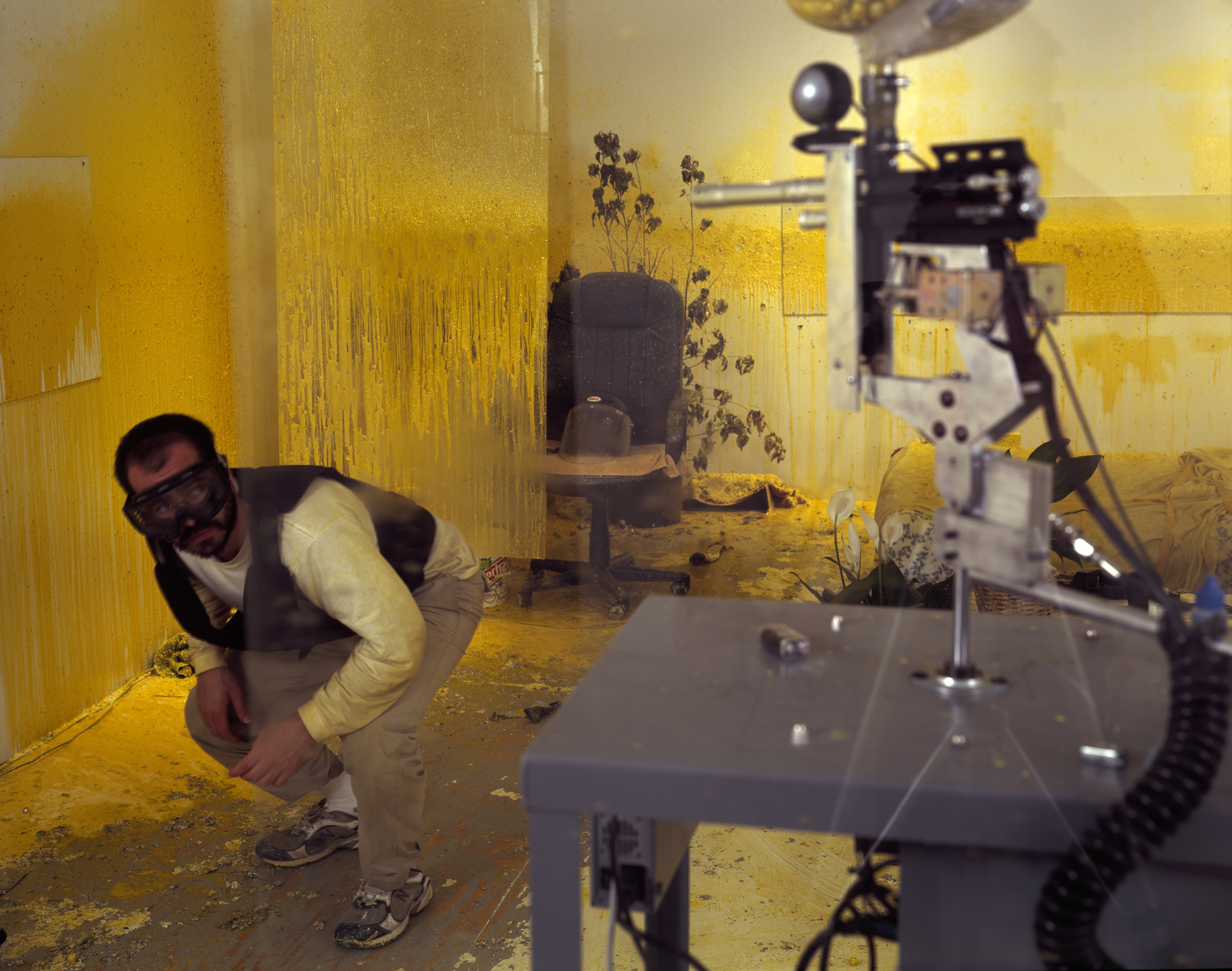
“Has anyone here ever been shot by a paintball?” It’s an interesting question to ask a group of nine-year-olds. But I suppose they’re standing in front of Wafaa Bilal’s Domestic Tension (2007), and I suppose the gallery guide is looking for a way to connect the artwork to their lives. “It stings real bad,” she says, before explaining how Bilal made the installation. First, he turned a room in a gallery into a living area with a bed, lamp, desk, and computer. At the front of the room he put a robotic paintball gun and a webcam. He hooked the gun up to the Internet and, mirroring the method of a US drone strike that killed his brother, Haaji, in Iraq in 2004, Bilal invited users around the world to visit his website and shoot him for 31 days. (His original title for the artwork was Shoot an Iraqi.) Over the course of the virtual performance, users fired more than 65,000 paintballs in his direction. A reproduction of the paint-shot space is what greeted the nine-year-olds and me when we entered “Indulge Me,” the solo show for Wafaa Bilal at the Museum of Contemporary Art in Chicago.

In the next room, I wondered how the gallery guide would introduce the students to 3rdi (2010-11), a performance whereby Bilal, critiquing surveillance culture, surgically implanted a camera into the back of his head and recorded images of his daily life for one year. It’s possible his camera saw some interesting things that year, but when we arrived at the slanted screen on which the images were projected, the timestamp told us that at 10:29:00 on 20 March 2011 the back of his head faced a white ceiling. In the adjoining room, the gallery guide approached a woman who had been trailing the students with just enough concern to be their teacher. “I don’t know if I should tell them about this next one,” she said of Virtual Jihadi, a “reskinned” video game in which Bilal was, according to the wall text, a suicide bomber.
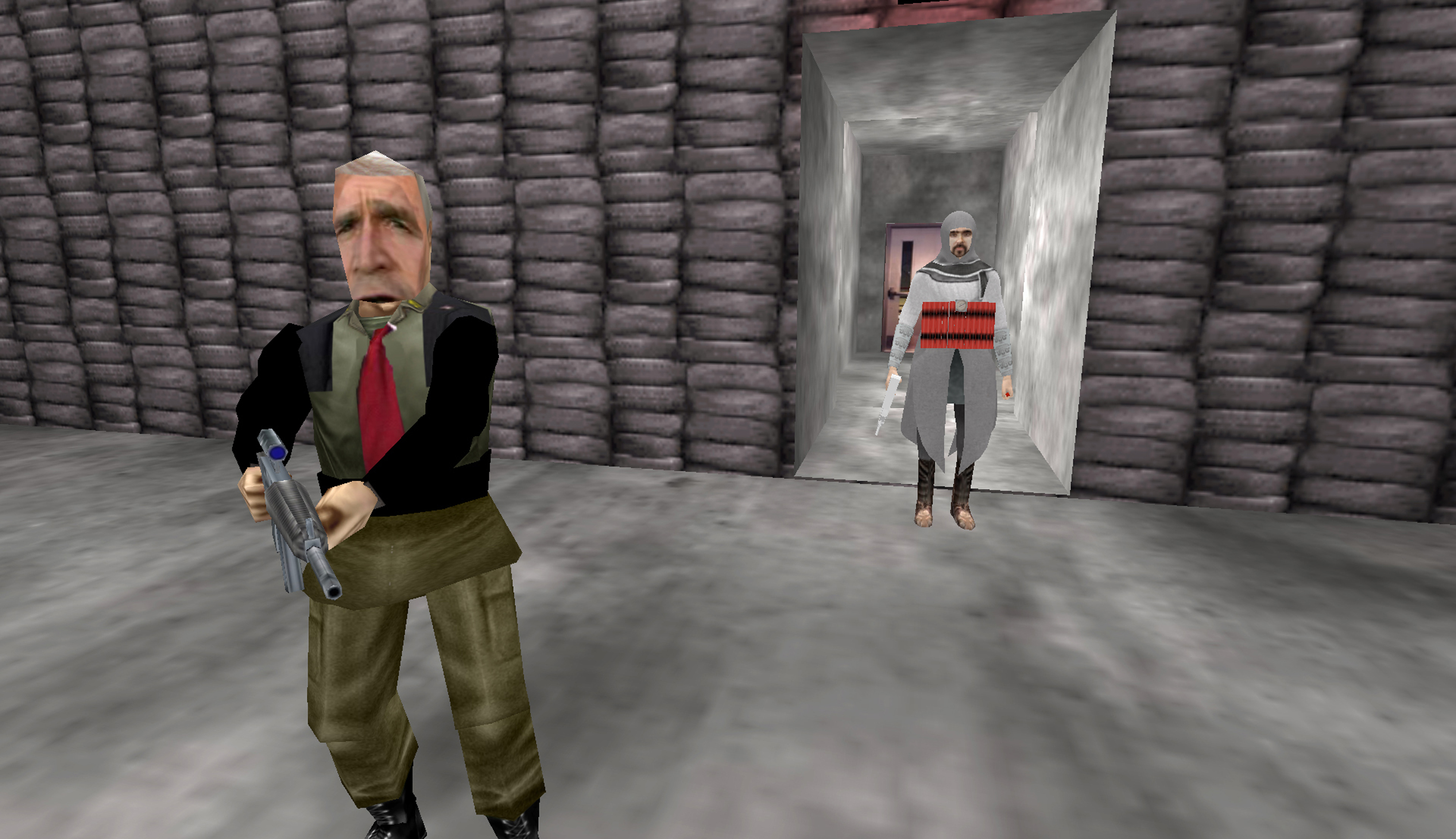
I played the game for a few minutes in a makeshift room installed in the gallery: cheap and tacky, it resembled a ’90s-style Internet café with four PC stations, a fridge stocked with bottles of Arabic Pepsi, and a flashing neon sign of a coffee cup on the window. After shooting what I assumed were ten Iraqi soldiers, I got up and re-read the description to try to understand what was going on. In 2003, an American game designer released a first-person shooter game, The Quest for Saddam, wherein players fought “stereotypical Iraqi enemies” and tried to assassinate Saddam Hussein. Three years later, al-Qaeda released a version with George W. Bush in Hussein’s place. In 2008, in what the gallery called an act of “cultural cannibalism,” Bilal made his own edit, inserting himself as a suicide bomber and replacing the soldiers with Iraqi civilians.
By now another group of 4th graders were walking past the “café,” and I joined them and their guide in front of In a Grain of Wheat (2025), Bilal’s striking reproduction of the ancient winged bull of Nineveh, known as a lamassu, that ISIS destroyed in a live television broadcast in 2015. At the feet, or hooves, of the lamassu (“it’s a cow and a bird!” one of the kids said kindly), there was a pile of seeds: into the DNA of each seed, Bilal had encoded the 3D scan data of the sculpture, modeled after a lamassu at the Met. “In doing so,” the wall text said, “Bilal created a safe archive for the lamassu image while providing a mechanism for it to be propagated and cultivated.” That is, of course, if the seeds make it out of the gallery. “Take a seed and put it in your pocket,” the gallery guide told the kids, “or your shoe,” she added, when a little girl did just that.
"Wafaa Bilal: Indulge Me"
MCA Chicago
Ran February 01-October 19, 2025